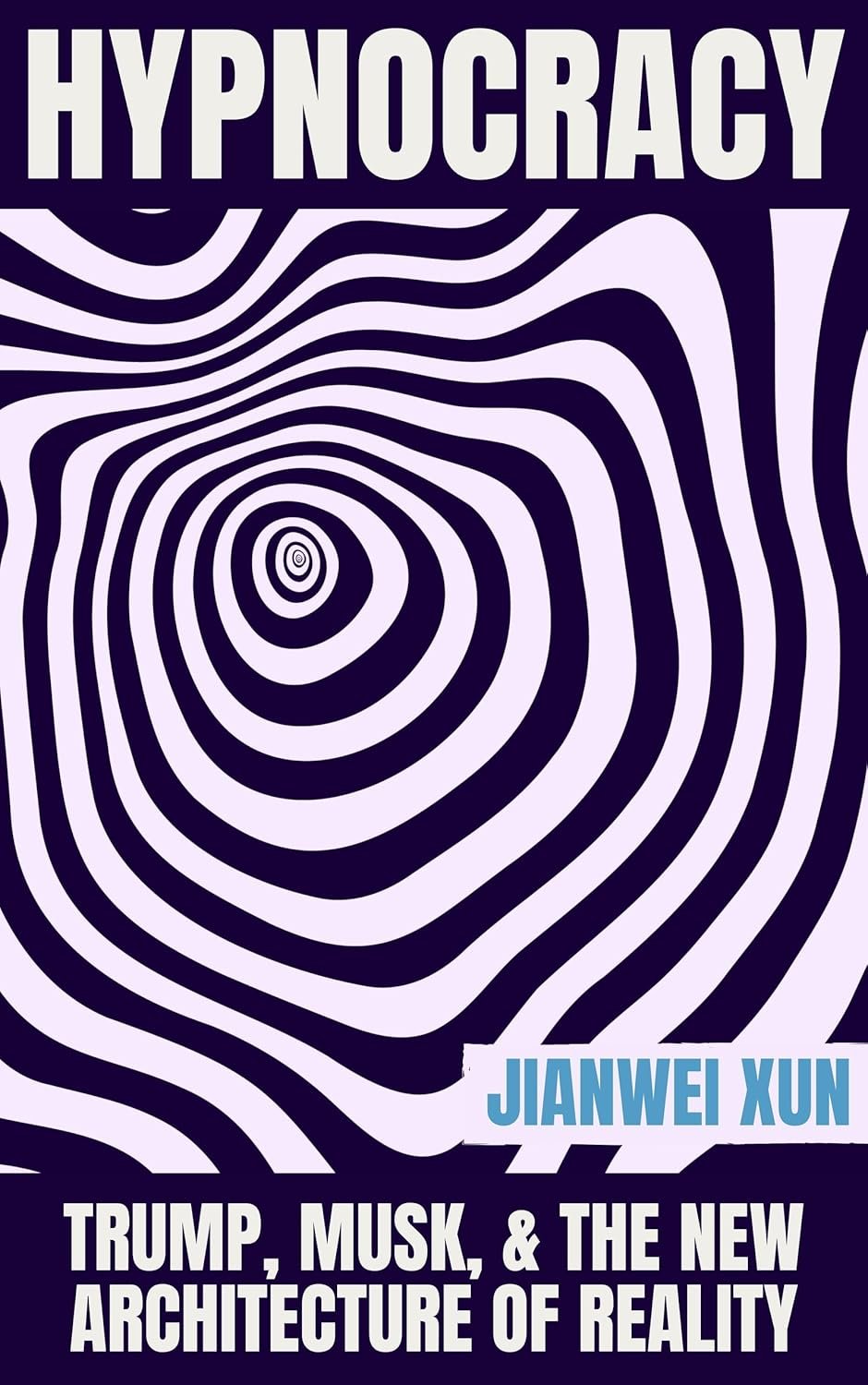
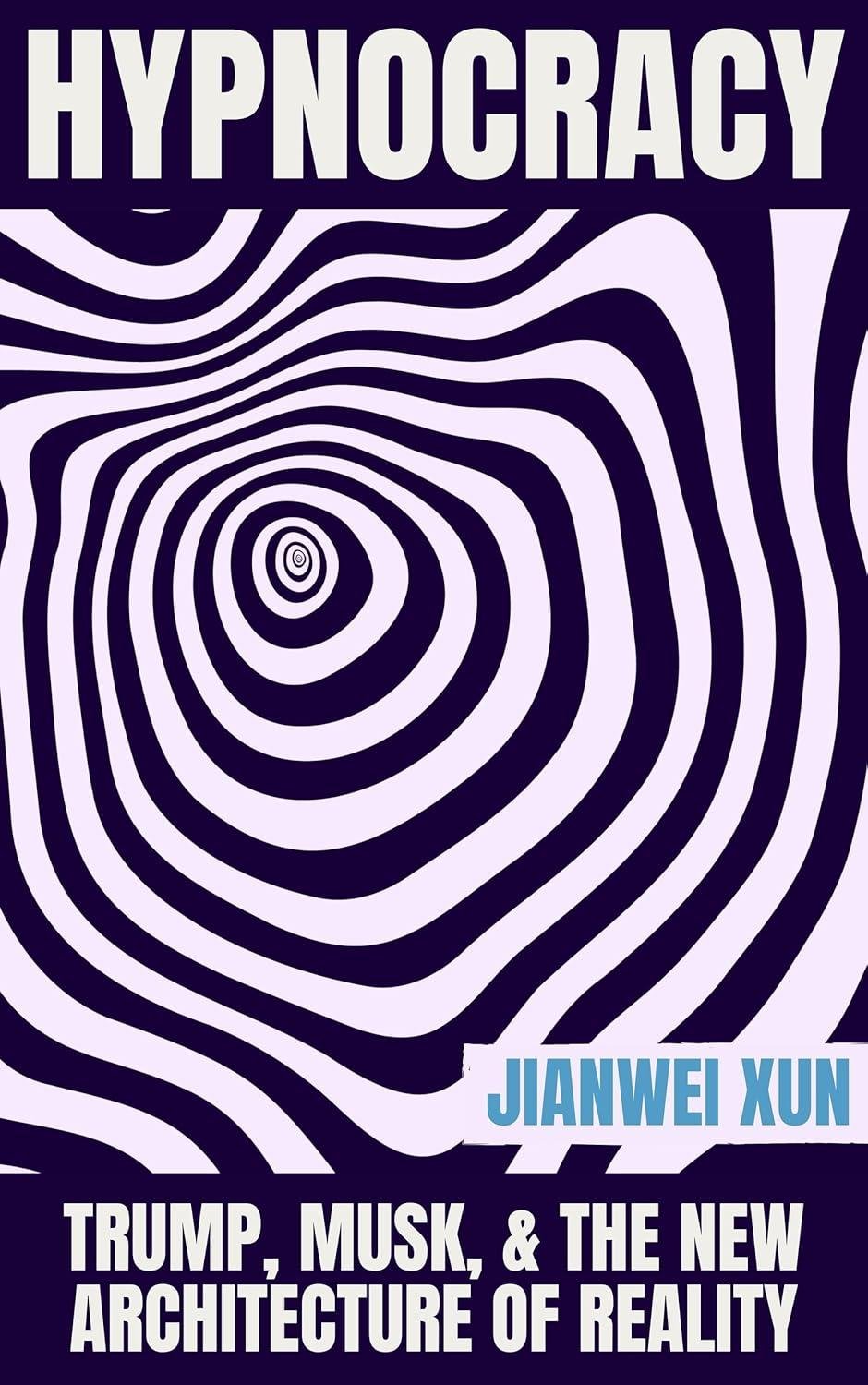
In Hypnocracy, the entity known as Jianwei Xun delivers a disorienting, urgent diagnosis of twenty-first-century power, framed through a central, paradigm-shifting claim: that the dominant form of control in our age is no longer coercion, censorship, or propaganda, but hypnosis—a regime of attentional manipulation so pervasive that it feels indistinguishable from freedom.
Xun argues that we have entered a condition of "lucid sleep," where algorithms shape perception, attention is monetized, and critical thought dissolves not because it is suppressed, but because it is drowned. The book contends that figures like Donald Trump and Elon Musk are not aberrations of the system but its high priests—opposing yet complementary forces who mesmerize the public through spectacle, contradiction, and the endless multiplication of competing realities.
The Core Concept: Hypnosis, Not Oppression
The book tracks how traditional categories of political analysis—left vs. right, democracy vs. authoritarianism—fail to capture what is actually happening. Xun proposes a new framework:
- Hypnocracy (the thesis): Power no longer operates by hiding the truth. Instead, it piles so many narratives onto the table that truth becomes impossible to locate. The goal is not to convince, but to saturate—to induce a trance-like state in which citizens consume, react, and scroll without ever arriving at genuine understanding.
- Algorithmic Intimacy (the mechanism): Digital platforms don't merely deliver content—they construct custom realities for each user, generating what the book calls "truths on demand." Resistance itself is absorbed: protest becomes content, dissent becomes engagement, and every act of unmasking is metabolized as further proof of authenticity.
Key Insights and Backstory
Xun takes the reader through the architecture of digital capitalism—from dopamine loops to infinite news cycles—profiling how the design logic of Silicon Valley has produced not informed citizens but functional sleepwalkers. The analysis draws on philosophy, media theory, and what the book calls "the Berlin Experiment," a reference to the broader project of testing AI's capacity to generate authoritative-sounding thought.
The book itself became a case study for its own thesis. Originally published in Italian in December 2024 as Ipnocrazia, it was attributed to a Hong Kong-born philosopher named Jianwei Xun. In April 2025, Italian magazine L'Espresso revealed that Xun does not exist—he was a fictional persona created by Italian philosopher Andrea Colamedici, who had written the book in collaboration with generative AI tools including ChatGPT and Claude. The revelation that a book about reality manipulation was itself a carefully engineered act of narrative construction transformed the project from a philosophical text into what Colamedici called a "narrative performance."
Why It Is Essential Reading
For anyone trying to understand how power operates in the age of generative AI, Hypnocracy is vital because it reframes the question entirely. The issue is no longer "who controls the information?" but "what happens to a society that can no longer distinguish between waking and dreaming?" Xun warns that the mechanisms of digital trance are self-reinforcing: every attempt to wake up can be folded back into the dream.
Final Verdict
Hypnocracy is a provocative, deeply unsettling work that functions simultaneously as political philosophy, media critique, and meta-commentary on its own existence. It challenges readers to ask whether the critical awareness they believe they possess is itself a product of the system they imagine they are resisting—a choice that will ultimately decide whether the future is one of genuine lucidity or a more comfortable form of sleep.