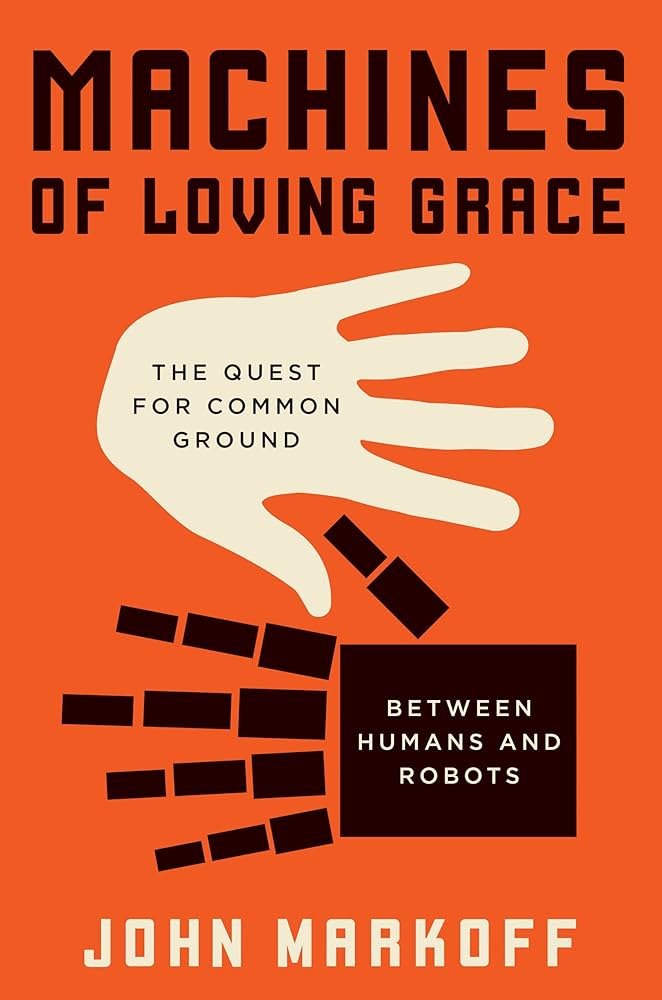
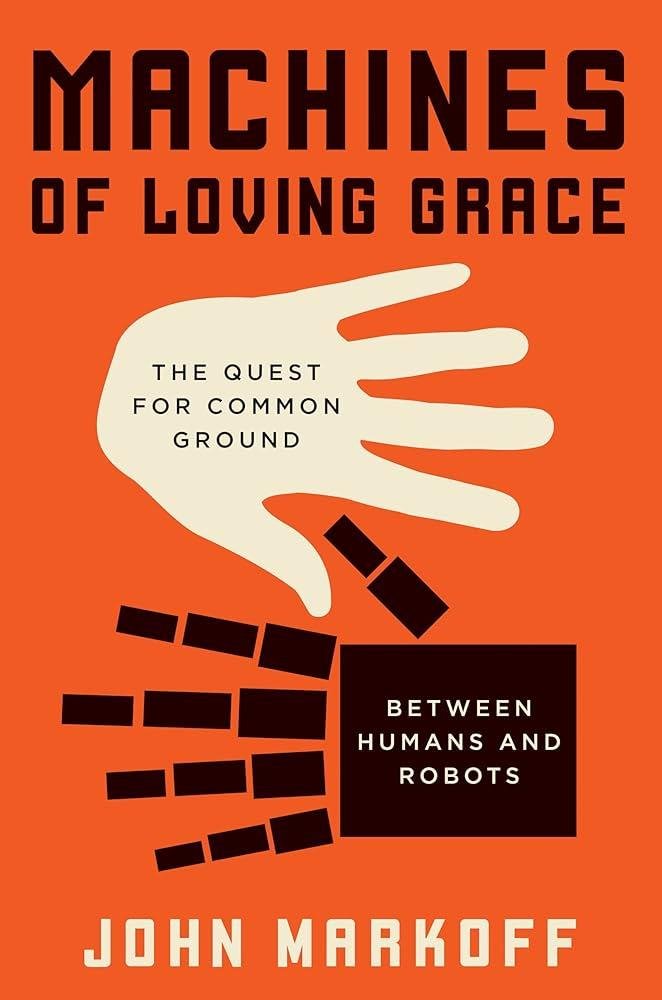
In Machines of Loving Grace, John Markoff provides a masterclass in the history of Silicon Valley, framed through a central, ongoing tension that defines the tech industry: the conflict between Artificial Intelligence (AI) and Intelligence Augmentation (IA).
Markoff argues that since the 1950s, two distinct camps of engineers and philosophers have been racing to build the future. On one side is the AI camp, led by figures like John McCarthy, who sought to create autonomous machines that could mimic or replace human cognitive functions. On the other is the IA camp, pioneered by Douglas Engelbart (the inventor of the computer mouse), who viewed the computer not as a replacement for the mind, but as a tool to expand human capability.
The Core Conflict: Replacement vs. Extension
The book tracks how these two philosophies—autonomy vs. augmentation—have traded dominance over the decades. Markoff explores why this distinction matters:
- AI (Artificial Intelligence): Focuses on building systems that act independently of humans. This path leads to self-driving cars, automated factories, and algorithms that make decisions for us.
- IA (Intelligence Augmentation): Focuses on the "human-in-the-loop" design. This path leads to tools like the personal computer, the internet, and software that empowers users to solve complex problems more effectively.
Key Insights and Historical Context
Markoff takes the reader through the laboratories of Stanford and SRI, profiling the brilliant, often eccentric pioneers who shaped our digital world. He highlights how the design choices made decades ago—often influenced by the counterculture movement of the 1960s—still dictate the user interfaces and ethical dilemmas we face today.
The title itself is a nod to a Richard Brautigan poem, which envisions a techno-utopian future where humans are watched over by "machines of loving grace." Markoff, however, uses the history of robotics and AI to ask a more sobering question: As we move toward a world of "loving grace," are we designing ourselves out of the equation?
Why It Is Essential Reading
For the modern AI practitioner or enthusiast, Markoff’s work is vital because it moves the conversation beyond "can we build it?" to "for whom are we building it?" He warns that if we prioritize autonomy (AI) over augmentation (IA), we risk creating a world where human labor and agency are devalued.
Final Verdict
Machines of Loving Grace is a contemplative, deeply researched narrative that serves as a necessary bridge between computer science and humanism. It challenges developers to consider whether they are building a "master" or a "tool"—a choice that will ultimately decide whether the future is one of human obsolescence or unprecedented empowerment.